Tuesday, 17 January 2017

Watton Priory barn - rescued from the brink.

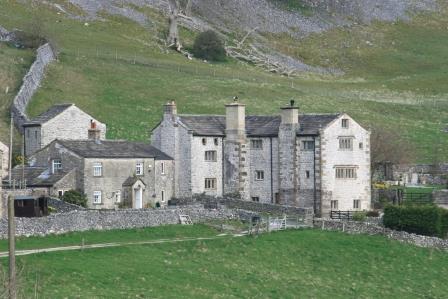
Watton Priory was a Gilbertine 'double-house' i.e. a monastery with separate halves for canons and nuns. Although there are extensive earthworks, the only remains above ground are the prior's lodgings and a large monastic barn. Until recently this fine late mediaeval barn was utterly derelict and in a state of imminent collapse. I had heard, however, that the owners had plans to restore it - so over New Year we went to see what has been done. It is very pleasing to see the huge barn repaired, re-roofed and ready for use once again to hold livestock or produce.
January 2017 after restoration

According to Pastscape, there may have been an Anglo-Saxon nunnery (Vetadun) on the site from the 7th to 9th centuries. This is mentioned in Bede.  Watton Priory was founded in 1150 by one Eustace FitzJohn in penance for having joined the Scottish side in the Battle of the Standard at Northallerton in 1138 when King David of Scotland had sought to capitalise of the chaos of the civil war between Stephen and Matilda to grab lands in the North.  Although the Scots lost the battle they held on to gains in northern England and continued to hold sway in there for the next two decades. Eustace, who owned extensive lands in the North, decided to back David. The Minsters of York and Beverley were allied to King Stephen, and the East Riding remained in English hands. Eustace's gesture of 'contrition' was therefore presumably necessary to keep sweet the ecclesiastical powers in this area.
The founding nuns and monks came from Sempringham in Lincolnshire, mother house of the Gilbertine order - the only home-grown English religious order. Accounts of Watton's financial state are contradictory; it is said to have been the wealthiest Gilbertine house and also that it was notorious for its poverty. The Gilbertines were a small, poor order so perhaps both statements are true. Although it owned lands in the East and North Ridings (including at nearby Kilnwick)  the priory perhaps still did not own enough to make it viable. It was also defrauded out of possessions or provisions on more than one occasion. During the Pilgrimage of Grace the Prior also abandoned his flock, leaving them with virtually no money on which to live.

The Prior's lodging (R) and former Dining Hall (L)
Watton was extensively excavated in the 1890s revealing the plan of two separate cloisters and associated buildings. The barn itself stood apart, a short distance to the north. The priory church was not the one to be seen now to the south, which is a parish church dating from the Tudor period. The original church formed part of the original monastic buildings beside the cloister. The church would have been divided down the middle so that there was no contact between the men and women. The canons only had direct contact when giving a dying nun the last rites. Confessions were heard through a slit the length of a finger and the breadth of a thumb, which nuns could also occasionally use to talk to their parents.

The lack of much to see above ground is probably due to the absence of natural stone in this area, the buildings likely having been part brick built and the site haveling been quickly plundered after the Dissolution by neighbours desperate for this scarce commodity. No monastery  in the East Riding has retained significant above-ground remains (or castle, for that matter - cf the abbeys of North Yorkshire where native stone is abundant.
Watton Priory - plan from 1890s excavations
Aelred of Rievaulx's account of the 'Nun of Watton' suggests that life in this neglected Gilbertine backwater was not happy or pleasant for its inhabitants. The account details Abbot Aelred's investigation into an incident where the nuns reacted to an episode of sexual impropriety between a nun and a lay brother with shockingly sadistic violence. This episode occurred in the 12th century and no documents shed any further light on life at Watton after this date.

At the Dissolution, Watton passed into the possession of Robert Holgate, its last prior (he who had temporarily abandoned the Priory in the Pilgrimage of Grace) future Bishop of Llandaff and Archbishop of York).
The Priory remains are visible from the main Beverley to Driffield Road and are accessible via a path out of the back of the churchyard. The church itself is worth a visit and contains the 13th century grave slab of one of the priors of Watton. The layout of the priory can be traced easily from the substantial earthworks.

Monday, 9 May 2016

One May morning - the worst 48 hours in Hull's history


Queen Victoria Square, early morning 9th May 1941 before
demolition of the Prudential Building tower
Hull's burning sky-line
On a bright May morning 75 years ago today, the people of Hull awoke to a scene of utter devastation. During two nights of the fiercest bombardment of WW2, 400 people had died, hundreds were seriously hurt and 10,000 people had been made homeless. Some poorer districts of the town had been obliterated as they lay near to the docks and riverside industrial areas which were Hitler’s target. The main shopping area of Paragon, Bond, Prospect and King Edward Streets had become one mass of fire. Also bombed were the Infirmary, City Hall, Guildhall, Paragon Station, the Fire Station where three firemen were killed, and many other key structures.  The Prudential Building by Queen Victoria Square received a direct hit, killing 16 people who were sheltering there. Its landmark tower, left standing precariously after a direct hit, was was demolished at 9am next morning. The five major department stores had been destroyed. Ambulance drivers, many women, drove through walls of fire to reach victims and the streets were filled with people fleeing the flames. The city’s fire brigade dealt with 800 fires over the two nights. All telephone communication between East and West Hull had been cut. It was estimated that between 32,000 and 50,000 homes were damaged or destroyed. During 1941 up to a third of the population took to sleeping in the fields outside the city at night to avoid the bombing raids. The bodies of many who died in the May bombing were unidentifiable and 200 were buried in a mass grave in one ceremony. Such was the outpouring of emotion on that occasion the council vowed never to do so again unless it was absolutely unavoidable.

In proportion to its size, Hull endured the worst bombing of any city outside London and much of this occurred in those two horrific nights between 7th and 9th May 1941. 95% of Hull homes were damaged or destroyed by the end of the war, making 152,000 people homeless. 1200 people were killed. The cost of the damage was estimated at £20 million pounds and arguably Hull has never recovered economically. None has been known to people outside Hull until relatively recently as the MOD applied a D-notice to reporting of the Hull Blitz. The Government did not lift this until the 1970s. It is difficult to see what justification there was for this and it did a great injustice to survivors of the Hull blitz.

Andrew Marvell stands on his plinth in front
of the ruined Co-op building
Those who are quick to make derogatory remarks about Hull would do well to remember these things. 75 years is not a long time. Not only are there many still alive with vivid and terrifying memories of that time, but such events leave an indelible stain on a city’s collective psyche. The fact that Hull could not hold its head up and have its wartime suffering recognised by the nation has, I believe, contributed to the lack of pride the people of Hull seem feel in themselves to this day.  The country is still forgetting - inexplicably the BBC has left Hull out of its forthcoming series on Blitz Cities. It also had the very practical effect that Hull did not receive the assistance it needed to get itself back on its feet economically. So don’t knock Hull. Its people endured much suffering to ensure that you and the rest of this nation kept the freedom you still enjoy today.

Wednesday, 17 February 2016

Fleeing persecution and poverty: European migration to Hull in the late 19th century


Been looking at where people in Bulmer’s Directory for Hull (1892) came from as a window on where Hull traded with at the time. Certainly there were a number of merchants living in Hull who originated in places like Hamburg, Holland, Sweden, Denmark and Norway (along with several Italian icecream sellers!) But what I also discovered told a much more unhappy story. Alongside the wealthy European merchants who had based themselves in Hull there were large numbers of more humble tradespeople. A quick survey of the names told that the majority of these were Jewish people of Eastern European or German origin. Comparison with earlier trade directories shows that most of these people came to Hull in the second half of the 19th century. Cross-referencing with 1891 census confirmed that they were mostly from Poland, Lithuania, Ukraine and other parts of what was the Russian empire at the time, as well as from Prussia. They seem to have practiced a small number of similar trades, mainly jewellers/watchmakers/silversmiths, tailors, cabinet makers, footwear manufacturers and tobacconists. Many of the jewellers doubled up as pawnbrokers of which there were a huge number in Hull at the time. (A crown on the statue of King Billy in Market Place was made in 1788 by Jewish immigrant silversmiths and presented to the town by the Jewish community.)

Whilst the persecution of the Jews by the Nazis in the 20th century is well-known, the wave of persecution by the Russian Empire in the 19th century is less familiar. This reached a peak in the 1880s. The Russian empire implemented increasingly harsh restrictions on Jewish people, pushing them out of eastern parts of the empire and restricting them to the so-called ‘Pale of Settlement’. Forbidden from living in the large cities or the rural areas, they lived together in  predominantly Jewish settlements known as shtetlech. In the 1880s life became difficult for Jews even in the shtetlech. As a result many Jews to flee the countries of their birth for Western parts of Europe like France, Germany and Britain. The places of birth mentioned in the 1891 census include many of the shtetlech - Lvov (Ukraine), Kovna (Lithiuania), Wilna (Poland), Mariampol (Lithuania) and Kelm (Lithiuania) for example.

The Jewish immigrants integrated quickly into the life of the city, developing some of the city’s most well know businesses and being influential in local politics. Apparently three mayors are buried in the Delhi Street Jewish cemetery, which is remarkable considering that at its height the Hull Jewish community only numbered a couple of thousand. However, world history shows this people - who the Nazis sought to wipe off the face of the earth - have made a contribution out of all proportion to their numbers in almost every area of life – whether medicine, scientific discoveries, politics, literature or music. This was certainly true of the Jewish immigrants who settled across Yorkshire in the 19th century.

Friday, 5 February 2016

Butterbumps and bitterns

In the vicinity of Weel there was a house named Butterbump Hall which was demolished in the 19th century. I thought this was a delightful name but wondered what a butterbump was. The answer gave another fascinating insight into the wildlife of the East Riding in times past. (See my previous post about beavers in Beverley)

Apparently a butterbump was an old Yorkshire name for a bittern. In my childhood, bittern were a bird of the south, coming no further north than East Anglia and the Fens. Only in the last decade or so have bittern returned to the East Riding where they are now regularly reported along the Hull valley. But they were once common when much of the East Riding was covered in fens and carr.

Nearby is another place name clue to the ornithological past. Storkhill neighboured Weel and is evidence of another vanished water bird that once frequented the area. White Stork have been extinct in Britain for many centuries.

Any other contributions of pieces of 'archaeo-ornithology' would be received with interest!

Saturday, 30 January 2016

Some Hull place names explained


Bransholme - either Bran's water meadow ir water meadow of the boar (brandt) Old Norse. Mentioned in t :) e Doomsday book
Drypool - a dried up pool, also Dripol or Dridpol
Gipsyville - 20th cenury, after nearby factory that manufactured 'Gipsy Black' polish
Holderness - headland (nes) of the hold (nobleman) - Danish (cf Stadtholder, the name given to the Dutch monarchs)
Hull - formerly Wyk or Wyke, meaning an inlet or bay in Old Norse/Danish but now taking its name from the River Hull whose name may be Celtic as many Yorkshire rivers are. Interestingly the course of the river has changed considerably and there used to be an inlet of the Humber in the area of Wyke to the west of the river called Sayercryk, probably Anglian for 'sea creek' and corrupted to 'Sewer'. This is presumably the origin of the otherwise unattractively named 'Sewer Lane' in the Old Town.
Marfleet - the pool stream, ?Norse
Myton - the name of the original settlement, the Monks of Meaux Abbey built a grange here and named it Wyke. The name persist e.g. in Myton Bridge.
Sculcoates - Skuli's cottages, old Norse
Southcoates - possibly old Norse, Soti's cote (cottage)
Stoneferry - earlier Stanfordrak - Stanford probably meant the stony ford and rak is Norse for a strip or lane, although it is difficult to imagine the river being shallow enough to ford - perhaps the ford was across a tributary stream. Later the site of a ferry across the river.
Summergangs - a road 'gang' across the Ings which was only passable in summer, or a corruption of 'South mere' - either way an indication that this whole area was once much wetter. The whole Southcoates / Summergangs / Drypool area was called Ings because it all consisted of wet meadowland in the flood plain of the river. Summergangs became a large area of common pasture but was too wet for use in the winter until drains like Summergangs Dyke were built.
Wincolmlee - no-one really seems to know the origin of this place name but the fact there is also a Wincolmblee in Newcastle would seem to suggest a Scandinavian origin. I am still looking into Wilmington and Trippett.
Wyke - a corruption of Norse 'vik' meaning mouth or creek.

Yorkshire Crafts

Traditional Yorkshire Crafts

Rag rugs
Also known as clippy rugs, peg rugs and proddy mats, rag rugs were the original household recycling activity. They are made out of small scraps of cloth cut into strips which are pushed through a piece of sacking with a pointed wooden tool to form tufts. Often the colours were just randomly distributed but sometimes they were formed into brightly coloured geometrical designs. A large rag rug would be found in front of the range in many working class households, from minors cottages to Dales farmhouses. Smaller strips were used as draught excluders along the bottoms of doors and the Dent museum has some nice circular seat covers made by the same technique. The tradition seems to have been strongest in West Yorkshire where clipping and lengths of selvedge from the textile mills were widely available, but were also associated with fishing districts such as Whitby and were made across the Dales.

Quilting and Patchwork
A quilt from Yeadon, W.Yorks
in the Quilters Guild Collection
The quilting tradtion most strongly associated with the North East also extended into parts of Yorkshire. For reasons I have not been able to establish quilt making seems to be particularly strong in mining areas, whether the coal mines of the North East, the Scottish lowlands, South Wales or the leadmines of Swaledale. They also stretched into neighbouring rural areas like Weardale and the Scottish borders. Many Yorkshire quilts are of the strippy type or the distinctive monochrome white and turkey red quilt. In fishing districts women often wore quilted petticoats, whose designs were drawn from wholecloth quilts. The Beamish museum holds examples from the northern parts of Yorkshire and examples are also held by small local museums like the Swaledale Museum in Reeth and the Beck Isle museum in Pickering.

Knitting
There was a small industry in the Yorkshire Dales in the 19th century knitting socks, caps, gloves and that kind of thing. I can remember when I was trying to learn to knit as a child being told by my grandad that it was 'like the Terrible Knitters of Dent'. 'Terrible' in this instance meant very skilled and fast. Knitting for Dent folk was definitely not a hobby but a desperate attempt to make ends meet in this most isolated of dales, where most households had to supplement the meagre income from hill-farming . All the family knitted, continuing knitting in the dark and even under the bedcovers when the candles had gone out. The women knitted as they walked around and performed domestic tasks. They could knit at an immense speed, knitting in time to traditional knitting songs and counting with the Dales counting systems used by shepherds to count their sheep. The use of these systems stretches across the Dales and Cumbria and share similarities with Welsh, suggesting that
Knitters in front of the Parish Church, Dent
they date back to pre-Roman times when a Brythonic language was used by the Celtic peoples of this area. They used traditional goosewing knitting sticks tucked into the belt to hold the needle. Dent folk were too pooorr to afford proper needles and made them instead from wire bought from the hardware shop. They sharpened these on the stones of the fireplaces. Apparently marks left by this process can still be seen in some farmhouses in the Dale. Whilst walking, the abllolf wool wwas hung from the waist on a clew hook. They made both plain, coarse every-day items and high-quality fine, patterned items which share similarities with the Sanquhar and Fairisle traditions. These tended to be in a two-colour scheme of natural white and dark wools  Good examples can be seen in the Reeth, Hawes and Dent museums.

In quite a separate tradition, the wives of fishermen along the coast knitted ganseys for their men
Hull fishermen wearing ganseys
folk.  Although the word gansey derives from Guernsey, Yorkshire was definitely the centre of production of ganseys although they were worn in some ither fishing communities like the east coast of Scotland. It is likely that the herring fleets who travelled to Yorkshire ports each year brought the knitting tradition with them, as girls also came down to gut and clean the fish landed. Each Yorkshire village hand its own style (e.g. Staithes, Scarborough, Filey, Flamborough) and each family its own variant on this pattern. If a fisherman drowned, those who found the body would know which village and family he belonged to from the design of his gansey. They were usually navy blue although a Sunday best one would be in a different colour. They were knitted in the round - tight fitting and with a high neck to keep out the elements. The designs reflected marine life, with anchors, ropes, waves, herringbone, flags and other symbols linked to the sea. Whilst walking balls of wool were carried on a clew-hook from the belt. In the Dales, knitters preferered to use a goose-wing knitting stick tucked into a ordinary belt. Designs still exist from places like Filey and Flamborough, where there is still a business selling traditional ganseys and the fishermen on their cobbles still wear traditional ganseys. Examples can be seen in places such as the Filey and Whitby museums. They were won with nothing underneath and just a neckerchief to stop chafing around the neck. Like the Dales knitters, knitters used a knitting stick and belt. Hull Maritime Museum holds a knitting stick carved in the shape of a fish.

Hattersley Loom (Copyright
Clem Rutter, used under creative
commons licence)
Weaving
The whole economy of West Yorkshire came to depend on woollen cloth production by the great mills but originally this was a small-scale domestic activity as it still is in the Western Isles. It is curious to note that the weaving of tweed, which is so associated with the Isle of Harris now, was acrtually introduced by a Yorkshireman on Hattersley looms developed in the county. There is little left of the hand weaving tradition in.Yorkshire now, but you can still see the old weavers houses in places like Holmfirth with long rows of windows in the upper stories. In Leeds you can also see the Cloth Halls where the weavers brought their cloth to sell, along with inns where they each merchant would trade their cloth.

Friday, 29 January 2016

Hull - not just about fish

Fishing may be what many people associate with Hull but it was a relatively insignificant part of the history and economy of the city before the 20th century. For most of its history, Kingston upon Hull has been a city built on European trade.

Wilberforce House, birthplace of the abolitionist, built in
1656 for the Listers, a wealthy merchant family
(Copyright Bernard Sharp, used under creative commons
licence)
The history of Hull is all about its geography. On the north bank of the wide Humber estuary on the east coast of England it faced the Low Countries and Germany with ports like Antwerp, Rotterdam and Hamburg. It also had ready access to the Nordic countries, the Baltic and Russia. Hull stands at the mouth of the smaller River Hull where it drains into the Humber. It was the town's proximity to the river Hull which gave Hull its initial prosperity, as wool travelled down the river from the lands of Meaux Abbey across the East Riding and was exported out of the port of Wyke (Hull). This came to the attention of the King who acquired Wyke for himself and granted it a Royal Charter in 1299, making it 'Kingston upon Hull'. Hull became part of the great Hanseatic league which had a virtual monopoly on trade in the Baltic, and imported timber, tar, resin, flax and hemp required for ship building, metal ores from Sweden and Scandinavian furs in exchange for cloth and grain. Another major import was wine. By the seventeenth century the influence of the Hanseatic league was waning but the fortunes of the Hull merchants continued to rise.

During the Industrial Revolution  Hull's position on the river Humber had become the more important geographical factor. The cloth produced in the mills of West Yorkshire, coal from the South Yorkshire mines, lead from the Dales and steel from Sheffield all flowed down the Ouse and Trent rivers via Hull to Germany, the Low Countries, Sweden, the Baltic ports and Russia.  These long-standing European trade links, although affected by wars in Europe from time to time, were much more consistent than the notoriously unstable American cotton trade, where slumps brought hardship and starvation to large parts of the Lancashire population. This was perhaps partly due to the diversity of ports which Hull traded with meaning merchants could tranfer trade in time of war - although the vessels used were often designed for a particular route such as the Hull to Hamburg route.

Unsurprisingly Hull became a major centre of ship-building. The materials required for this like tar, hemp and timber were imported by the Hull merchants. Hull shipbuilders built some very well known vessels, including the 'Bounty' of mutiny fame. Each merchant family had his staithe on the west bank of the river with its warehouse. Behind the merchants built fine houses which faced onto the High Street. This layout is still visible today. You can view the cobbled Bishop's Staithe and Blaydes' Staithe leading down to the riverside and the grand houses belonging to the Maister, Blaydes and Wilberforce families. You can also view the old dry docks by Myton Bridge and on Dock Office row where it was entirely natural to see the prow of a ship poking out between two houses.

Prince Street Hull (Copyright Paul Harrop
used under creative commons licence)
The late 18th and early 19th centuries were the peak of prosperity for the city and this is reflected by the number of fine Regency houses around the Old Town. The town walls had to be removed to give the population more room to expand. The merchants and ship owners moved out to desirable addresses in the suburbs like Anlaby Road, Coltman Street and Cottingham. The town had a flourishing social life with several theatres, botanic gardens, etc. The ancient Hull Grammar School educated the likes of William Wilberforce while new colleges like Kingston College, Hull College and Hymers College were founded to meet the needs and aspirations of this burgeoning merchant class. The city was home to many grand civic buildings. Fittingly, one of the finest buildings in the town was the new Dock Offices proudly positioned by the lock between Prince's and Queen's Docks. Hull merchants invested their money in all the enterprises of the Victorian era like trams and the Hull and Barnsley Railway. Altogether the Hull merchants were a highly influential and prosperous group in the 19th century on both a local and a national level.

Hull also developed a number of manufacturing industries of its own and it is interesting to see how these apparently disparate industries sprang up. For example, Hull's rapeseed oil industry developed into the paint industries which used oils in their production and alongside this was a trade in brush manufacture. 'Humbrol' of Airfix model fame was originally the Humber Oil Company. Crown Paint is also based in Hull. Cod liver oil which improved the nutrition of generations of British children for was first manufactured by Mr Smith and his Nephew - a FTSE 100 company still based in the city. It was also a centre of corn milling and this evolved into a starch industry. This is where Reckitt and Coleman began. They became one of the cities biggest employers and manufacturers of dozens of iconic British brands like Brasso and Dettol. Close to Reckitt's Dansom Lane factory stands a building which was a large nineteenth century corn mill and further along Holderness Road is the wind-powered mill that belonged to J. Arthur Rank's father Joseph.


Secretaire bookcase by
Mordecai Kitching of Hull
Hull was a centre of very fine cabinet making and of the manufacture of church organs which may be linked not only to its trade in timber but also to close cultural links and flow of skills between Hull and the great musical centres of Germany, the Netherlands and the Baltic. Hull was also home to fine watch and clockmakers, jewellers and silversmiths. Many of the highly workers in these small industries were refugees fleeing antiSemitic persecution in Eastern Europe.

Thus a visitor to nineteenth century Hull would have been struck by a culturally vibrant, properous and cosmopolitan city whose merchants proudly displayed their new-found wealth in fine civic and commercial buildings and in infrastructure like new railways, trams and docks. If Hull is to recover her civic pride I feel her citizens need to rediscover and connect with this great mercantile past and the associated trade in ideas, arts, culture and skills which came with it from Northern Europe.

Wednesday, 27 January 2016

What's with all these Hall Garths in the East Riding? More mediaeval manors.

You might notice that there are many sites named Hall Garth around the East Riding. The name indicates a site of some antiquity, usually the site of a mediaeval moated manor. Garth was a Norse word for an enclosure and later a garden. In the Middle Ages before extensive drains were constructed most of what is now arable land around the Hull valley was marshy and frequently flooded. Those who could afford to do so would build on a moated platform to manage the flooding issue. This also offered a defensive aspect but this may have been a secondary consideration. Sites named Hall Garth can be found at the following locations:-
  • Beverley - common land facing the Minster across Keldgate. This was the site of the archbishop's palace, of which the earthworks can still be seen in the pasture where a noticeboard gives more information about the site. It was known as Bishop's Dings also. Dings in old Germanic languages meant a place of assembly or trial. The buildings probably included a jail as the Archbishop carried authority in mediaeval times akin to a king. Excavations of the site revealed that there were a number of substantial buildings and a timber bridge which may have been a drawbridge over the moat. 
  • Hornsea - the earthworks of Hall Garth are still visible in what is now a park, including parts of the moat. The manor belonged to St Mary's Abbey in York. 
  • Goodmanham - the listed building now on the Hall Garth site is not the mediaeval one but the 19th Century Rectory.
  • Burstwick: Burstwick was a Royal manor and one of the most influential in the country in its day. It was an extensive, square-moated site, probably fortified. The buildings included a dovecote, windmill, two chapels and inner and outer gatehouses. There are fishponds and other remains also.
  • Lockington - south of the village, now occupied by a house of the same name which dates from the 1600s.
  • Bishop Wilton - Archbishop Neville built his manor here and the earthworks can  be seen at the eastern end of the village. The moat is still partially flooded. There was probably a gatehouse in the South West corner. There are remains of two mediaeval fishponds. The village also has a very impressive Norman church which features on the Sykes churches trial. 
  • Leven - to the west of the village. The manor of Leven was said to have been given by Edward the Confessor to the collegiate church of St John of Beverley who retained it until the Dissolution. The farm at Hall Garth has been so called since at least 1650 and is likely to be the site of the manor house. Heigholme was added to the manor of Leven and was the location of a moated manor house which was eventually replaced by Heigholme Hall. 
  • Pocklington - originally in the hands of the crown and the Dukes of Albemarle, this passed into the hands of the de Pokelyngtone family. The Hall Garth is thought to have stood at the site which later became known as Teresa Cottage. 
  • Faxfleet - this little village lies in what would have been fens in the Middle Ages. Some of the land belonged to Thornton Abbey across the water in Lincs - still the site of one of the UK's most impressive late monastic gatehouses. The manor itself came into the possession of the Knights Templars - indeed, it was some of the first land given to the Order in England. This was probably given by the Lords of Broomfleet. . They established a preceptory at North Ferriby. 
Other sites which are not called Hall Garth but are moated sites of a similar nature include Cowick, North Duffield, Riccall, Howden, Leconfield, Cherry Burton, Bishop Burton, Scorborough, Roos, Hedon, Winestead, Harpham, Kexby, Everingham, Haisthorpe, Bransholme and Etton . Whether the name of the Cottingham residential home Hallgarth has any historical origins I have not been able to establish but its location near the original central crossroads of the mediaeval village near to the parish church suggests this.

Thursday, 31 December 2015

Dickensian Hull

I was recently looking at Victorian photographs of places that featured in Dickens' novels - ancient inns, poor homes crowded around dark alleyways, scenes of the riverside, tumbledown town houses of another era. Dickens vividly portrayed the other, darker side of a prospering city.
In the eighteenth and nineteenth centuries Hull was also a city on the up but these pictures portrays the life of its less fortunate inhabitants and a world that Dickens could easily have set one of this novels in.
Chaffers Alley at the turn of the 19th century
Brown's Entry in the Old Town.
By the mid 19th century the merchants had moved out of their riverside houses in the over-crowded Old Town to smart new houses in newly developed areas like Anlaby Road and Coltman Street. Every narrow street in the Old Town had numerous alleyways and yards leading off it where ancient dwellings were packed so close together that some never received direct sunlight.
 There were a number of 'hospitals' around the old town which were really almshouses for the elderly and infirm, enabling some to avoid the Hull Union workhouse off Anlaby Road. This is Crowle's Hospital on Sewer Lane, founded by merchant George Crowle in 1661. Some, such as Gregg's Hospital, were of much older date - founded in the 1400s.

High Street
Although many mediaeval buildings had been pulled down in the eighteenth century to make way for the fine Georgian town houses which now characterise the Old Town, there were still many with their jettied stories that projected over the narrow streets.
 Several 17th century merchant houses still stood on the High Street, mostly in a dilapidated state, amongst fine buildings of a later date like Maister House which now belongs to the National Trust. Of these, only Wilberforce House survives to the present day - victims of changing tastes and the bombardment of the Old Town in two world wars. This is Crowle House, High Street - built 1664. Most people in the town would depend directly or indirectly on this European trade for their living and the merchants were the most powerful men in the town. They were the councillors,  aldermen and MPs in a town once notorious for political corruption. They were on boards of schools, the hospital and the workhouse and of the tram company, docks company and railway.  They governed the police and if you were up before the beak there was more than a passing chance the magistrate would be a merchant too.
The Town Docks and the Old Harbour were still the hub of the city, crammed full of tall ships, steamers and barges. Sailors from Hamburg, Antwerp, Rotterdam, Dunkirk, the Baltic and  would go ashore into the many taverns on the riverside along with the local sailors. The taverns of High Street and Trippett were a frequent target of the press gangs.


Saturday, 30 May 2015

Meaux Abbey - a forgotten part of Hull's history

Meaux Abbey earthworks in winter
(copyright Paul Glazzard,
used under creative commons license)
If you go to Meaux Abbey, about seven miles north of Hull, don't expect to find impressive remains like those at Fountains or Rievaulx. Even if you managed to find the tiny hamlet of Meaux there is nothing left of the Abbey but a few earthworks. It is hard to believe that those few bumps in a field were once an influential Cistercian house like Rievaulx without which the city of Hull would never have existed.


Kilnsey Old Hall, a grange of Fountains Abbey
(copyright the author, 2009)
The monasteries were a key part of the mediaeval economy and owned large areas of land and property. To provide money for the monks, lay brothers ran farms called granges* which not only provided food and clothing for the brothers but produce for sale. A key product was wool. Around 1200AD the abbey acquired land at Myton and established a grange there. The settlement which grew up around it was called Wyke and would become the town of Hull. Myton was ideally situated, where the river Hull flows out into the Humber, for the export of fleeces from the Abbey's lands to markets in Western Europe. Like many fine churches in East Anglia, Hull's beautiful Holy Trinity Church was built with the proceeds of the wool trade in around 1300

Holy Trinity Church, Hull
(copyright David Wright 2006,
used under creative commons license)
.

At this time, the Abbey was busily draining large areas of land in the Hull Valley and creating more pasture for livestock. In the process it formed many of the inland waterways which still link to the River Hull today. Beverley Beck, for example, is a very ancient watercourse that carried wool the couple of miles from from the town's market to the River Hull and down to the Humber.

'Wyke of Hull' rapidly became one of the most successful wool towns in the country. By 1205, only London, Boston, Southampton and Kings Lynn paid more in wool tax, and Wyke exceeded not only traditional local wool markets like Beverley and Hedon but also the city of York. Most of the wool merchants were from elsewhere, particularly the continental regions of Flanders, Holland, Germany and France. English merchants were from local wool towns like Beverley. Instead, the Abbey and inhabitants of Wyke made their money from port dues and from all the infrastructure that went with the mercantile trade such as inns. The Abbey was the effective civil as well as ecclesiastical authority in the town with its own jail and courts.

By the late 13th century Meaux Abbey had got itself into financial difficulties. It had also come to the attention of the King that Wyke was a much more favourable port than the ports of Ravenser and Hedon which already belonged to the crown. Thus in 1293 Edward I acquired the town and its port. The abbey was very disgruntled at the price, but presumably was not in a position to argue when the buyer was the king and when they were deep in debt. Thus came to an end the influence of the Cistercians in the area. In 1299 Edward I granted a royal charter and Wyke began a new era as 'the King's town on the river Hull'. It has proudly borne three gold crowns on its coat of arms ever since, although ironically has been something of a hot-bed of republicanism from the Civil War, when it refused entry to King Charles I, to the present day when it was the only city in the country not to apply for any licenses to hold a street party to commemorate the Queen's jubilee!

One look at a map shows the wisdom of Edward's choice. The town of Ravenser no longer exists at all, having been long since lost to coastal erosion, and the village of Hedon is now so far from water it is hard to believe it was once a port. Wyke, on the other hand, is now a city of more than 250,000 people and went on to become one of the wealthiest mercantile towns in the north. But more of that in a later post...

* A good example of a grange can be seen at Kilnsey in Wharfedale which belonged to Fountains Abbey. Wool was taken from Kilnsey along Mastiles Lane. This monastic drover's road can still be followed from Kilnsey to Malham and is a very pleasant walk of about 5 miles.

Friday, 13 February 2015

Origins of some East Riding place names


Aike - I haven't been able to find the origin of this name, although the local expression 'Yacker backer Arram' makes me wonder if it derives from the Viking 'yacker' (acre). It is interesting to note that in early times Aike was an island in the River Hull.

Aldborough - old fortress (Viking)

Anlaby - 'Olafr's farm (Viking)

Bilton - Billa's farm (Viking)

Bridlington - settlement of Beortel's people (Anglo-Saxon)

Cawkeld - would appear to be Viking, as kelda is Old Norse for a spring. Cawkeld is an area of low lying pasture with springs where water from the chalk wolds above flows into the feeder streams of the river Hull. Perhaps it meant cow springs or cold springs.

Cottingham- Ket's (Ceridwen, a deity) or Cotta's people's place (Anglo-Saxon or mixed Anglo-Saxon and Celtic)

Dunswell - ?from Douceville in reference to a large number of springs/wells in the area

Eske -  this long depopulated settlement on the east bank of the river Hull has a Viking name meaning ash tree. This is the same root of Norse names in other parts of Yorkshire like Askrigg in Wensleydale (ridge of ash trees)

Flamborough - Flein's fort (Viking)

Fridaythorpe- Fridaeg's farm (Viking)

Goodhamham - settlement of Godmund (Anglo Saxon) - Goodmanham was the site of a major pagan shrine (where the parish church is now located) and the capital of the Anglian kingdom of Deira

Hunmanby - hundsman's farm (Viking)

Hutton - high farm (old English)

Keldmarsh - a compound name. Keld is Viking for a spring. This area is still a marshy area with springs, and is now a nature reserve belonging to the Yorkshire Wildlife Trust

Kilnwick - Cylla's farm (Anglo-Saxon)

Kirk Ella - the origin is disputed. It may mean the place of worship of Ella, or Ella may derive from aelf lea, the Elves clearing, with Kirk distinguishing it from other locations e.g. West Ella

Leven - one of very few Celtic place names in the area, the others being the names of rivers like the Humber, Hull, Ouse and Derwent. The invading Anglians almost obliterated the Celtic heritage of the area. Leven derives from 'llyfn' meaning smooth

Lund - Viking for a grove. There are regions in Sweden and Norway of the same name

Marfleet - marr is Norse for sea, while fleet is both Norse and Old English for a stream or creek
 
Meaux - Originally Melsa/Melse - Scandinavian/Anglo-Scandinavian, meaning a sandbank in a pool. Francophone spelling adopted by the Cistercian monks of Meaux Abbey whose mother house was in the French town of Meaux.  

Pocklington - Anglian settlement of Poca's people

Skerne - an Old English name meaning bright/clear but modified with the 'sk' sound to be pronounceable by the incoming Vikings

Skidby - clearly Viking in view of the 'sk' sound and the -by ending. Probably means either Skitr's farm or the farm in the place for gathering firewood

Storkhill - Stork appears to be an Anglian name referring to an island of Storks. Storkhill is one of the water towns of Beverley, the others being Sicey, Sneerholmes, Thearne, Tickton, Weel and Woodmansey.

Sunderlandwick – deserted village near Driffield. Probably meaning the dairy farm in the 'sundered land' (i.e. set apart - in the case of the NE town of Sunderland, a monastic designation) 
 
Sutton - Anglo-Saxon meaning 'south town' - in this case, the south town to Wawne.

Thearne- Anglian: a thorn tree

Tickton - Tica's farm (Anglian)

Walkington – Anglo-Saxon, meaning either settlement of Wealca's people or settlement of the Welisc. The Anglo-Saxons referred to the British tribes they displaced as Welisc or foreigners. This is where the word Welsh derives from, and these displaced tribes would have spoken an early form of Welsh.
 
Wawne - Anglian meaning a quagmire.

Wetwang - this name appears to be Norse but the exact meaning is unclear. Vangr means field (c.f. Stavanger) and vaettr may mean a summons to a trial for an action.

Weel - Anglian for a whirlpool

Wilfholme – holme can mean a low flat island but more often locally it refers to a water meadow and there are many located along the River Hull (Snakeholmes, Cattleholmes, Fishholme, Featherholme, Hempholme, Standingholme, Hallytreeholme, Heigholme, Sandholme, Sneerholmes and Bransholme, just to name the ones immediately beside the River Hull!)

Woodmansey - Anglian. A woodman's pool


Wednesday, 21 January 2015

Visitors from the arctic

I'm looking forward to seeing what wetland birds the winter blows in to the Hull Valley. Visitors from the arctic frequently include pink-footed, barnacle and white-fronted geese and whooper swans. The resident greylags and canadas at Hornsea Mere are habituated to flock to any human being appearing with a plastic bag. I noticed a solitary barnacle goose among some resident geese last year and was amused to watch it carry on grazing oblivious as all its companions charged furiously towards a visitor who stepped into their midst to feed them. Clearly this wild northerner hadn't learnt what comes out of plastic bags. Actually this behaviour can get quite annoying at the Mere as the birds appear the minute you stop your car and some are very persistent, like this swan who had a good look at us through the car window.

It's good to see that the bitterns are back at both Hornsea Mere and Tophill. Two of my favourite ducks, the red breasted merganser and the goosander, have also been in evidence. The merganser has a delightfully adolescent spiky hairdo. The male goosander is truly beautiful bird with a bottle green head, crimson bill and sleek white body flushed with salmon pink. We saw both at Tophill last year but unfortunately too far away to get good pictures.


This super little family made lovely end to a fantastic week of wildlife in Skye last year, however. It was pouring with rain, getting darker all the time and seeming like it was time to turn in for the night, when along came this adult with seven babies - each with a miniature version of the distinctive sawtoothed bill. I would love to see goosanders with chicks as they have a very endearing habit of letting them ride 'piggy back' - sometimes the whole brood struggling to get on board at once!

Waxwing weather

It's waxwing weather. Temperatures here are below freezing and we've had several falls of snow over the last week. It's this kind of weather that blows in flocks of birds like waxwings, redwings and fieldfares that feast on berries in trees and hedges. I had a most unlikely encounter with waxwings one bitter, icy morning when I arrived at work and spotted a bush full of these beautiful passerines in the hospital car park. They are so named because their wings look as if they have been splashed with scarlet and yellow sealing wax.

The redwing and the fieldfare sit at opposite ends of the size range of British thrushes. The redwing, distinguished by a russet underwing which is most apparent in flight, is the smallest whilst the fieldfare is a large thrush which is distinguishable from song and mistle thrushes by a lot of grey in its colouring - on the head and rump - and v shaped spotting on the breast that gives the appearance of a herringbone tweed waistcoat! Fieldfares are usually seen in flocks and prefer fields and hedges but sometimes drift into gardens in a harsh winter. Last winter a relative told me he had watched a flock of fieldfares strip the rowan in his garden bare whilst on the phone to a friend!

So far I haven't seen either species this winter but both have been reported at nearby places in the Hull valley. I have had to make do with a huge mistle thrush hopping around my neighbours front lawn but I shall be keeping my eyes open and the binoculars handy.

Thursday, 18 July 2013

Yorkshireisms


It’s only as I’ve got older and seen the uncomprehending looks on my friends faces that I've realised how local some of the sayings were that we used at home. Yorkshire sayings, like Yorkshire people tend to be very apt, blunt and with a dry sense of humour. Here’s a selection. I can’t guarantee these are the exclusive preserve of Yorkshire and a few may have crept in via my relatives from ‘t’other side o’ t’hill’!
Health

Not surprisingly I can't think of any euphemisms for 'absolutely smashing, thank you' but quite a few expressing the reverse! A suitably non-commital reply to enquiries would be 'Fair to middlin''. ‘'Ee looks lahk death warmed up’  would suggest something a little worse, whilst ‘Ee’s popped ‘is clogs’ means that he’s died. Apparently expression comes from when a mill-workers wife would pawn his clogs after his death.

Intellect
Yorkshiremen are not know for being over-generous with complements and you are more likely to find sayings concerning the want of brains rather than the reverse.


Thick as two short planks

Very stupid

Daft as a brush

Ditto

He’s so sharp, he’ll cut ‘imself

He’s being a clever-dick

Listen who’s  been in t’knife-box!

Put down to a clever-dick

Not ser green as cabbage-lookin’

She has more brains than would be suggested by appearances
 
Money
Money is a matter reputed to be very close to a Yorkshireman's heart, so not surprisingly there are a lot of witty sayings to do with money. The most famous is the ditty 'Hear all, see all, say nowt; Eat all, drink all, pay nowt; And if tha does owt for nowt, do it for thisen.'
Others include:

She’s got money to cobble dogs

She’s very rich (can afford to throw money at dogs)

You’re cheaper to keep for a week than a fortnight!

To someone who eats a lot/has expensive tastes

They haven’t got tuppence to rub together

They are very poor

More brass than brains

More money than sense

She looks like she’s lost a pound and found a shillin’

She doesn’t know whether to be happy or sad

Where there’s muck there’s brass

 
Food
We like to eat well in Yorkshire, so lets have none of that minuscule, pretentious, art-on-a plate nonsense!

‘All clout and no dinner’

From the era when working men took a meal wrapped in a cloth to work. An expression for a disappointing item which is all packaging and nothing inside

Yer could put it in yer eye corner and see no worse!

Derogatory remark about the size of the item

It’s like feeding elephants comfits

Something which comes in stupidly small pieces

Neither nowt ner summat

Mediocre

Hard as the old lad

Very hard

Burnt to snicksnarls

 Done to a cinder