Showing posts with label Hull. Show all posts

Friday, 29 January 2016

Hull - not just about fish

Fishing may be what many people associate with Hull but it was a relatively insignificant part of the history and economy of the city before the 20th century. For most of its history, Kingston upon Hull has been a city built on European trade.

Wilberforce House, birthplace of the abolitionist, built in
1656 for the Listers, a wealthy merchant family
(Copyright Bernard Sharp, used under creative commons
licence)
The history of Hull is all about its geography. On the north bank of the wide Humber estuary on the east coast of England it faced the Low Countries and Germany with ports like Antwerp, Rotterdam and Hamburg. It also had ready access to the Nordic countries, the Baltic and Russia. Hull stands at the mouth of the smaller River Hull where it drains into the Humber. It was the town's proximity to the river Hull which gave Hull its initial prosperity, as wool travelled down the river from the lands of Meaux Abbey across the East Riding and was exported out of the port of Wyke (Hull). This came to the attention of the King who acquired Wyke for himself and granted it a Royal Charter in 1299, making it 'Kingston upon Hull'. Hull became part of the great Hanseatic league which had a virtual monopoly on trade in the Baltic, and imported timber, tar, resin, flax and hemp required for ship building, metal ores from Sweden and Scandinavian furs in exchange for cloth and grain. Another major import was wine. By the seventeenth century the influence of the Hanseatic league was waning but the fortunes of the Hull merchants continued to rise.

During the Industrial Revolution  Hull's position on the river Humber had become the more important geographical factor. The cloth produced in the mills of West Yorkshire, coal from the South Yorkshire mines, lead from the Dales and steel from Sheffield all flowed down the Ouse and Trent rivers via Hull to Germany, the Low Countries, Sweden, the Baltic ports and Russia.  These long-standing European trade links, although affected by wars in Europe from time to time, were much more consistent than the notoriously unstable American cotton trade, where slumps brought hardship and starvation to large parts of the Lancashire population. This was perhaps partly due to the diversity of ports which Hull traded with meaning merchants could tranfer trade in time of war - although the vessels used were often designed for a particular route such as the Hull to Hamburg route.

Unsurprisingly Hull became a major centre of ship-building. The materials required for this like tar, hemp and timber were imported by the Hull merchants. Hull shipbuilders built some very well known vessels, including the 'Bounty' of mutiny fame. Each merchant family had his staithe on the west bank of the river with its warehouse. Behind the merchants built fine houses which faced onto the High Street. This layout is still visible today. You can view the cobbled Bishop's Staithe and Blaydes' Staithe leading down to the riverside and the grand houses belonging to the Maister, Blaydes and Wilberforce families. You can also view the old dry docks by Myton Bridge and on Dock Office row where it was entirely natural to see the prow of a ship poking out between two houses.

Prince Street Hull (Copyright Paul Harrop
used under creative commons licence)
The late 18th and early 19th centuries were the peak of prosperity for the city and this is reflected by the number of fine Regency houses around the Old Town. The town walls had to be removed to give the population more room to expand. The merchants and ship owners moved out to desirable addresses in the suburbs like Anlaby Road, Coltman Street and Cottingham. The town had a flourishing social life with several theatres, botanic gardens, etc. The ancient Hull Grammar School educated the likes of William Wilberforce while new colleges like Kingston College, Hull College and Hymers College were founded to meet the needs and aspirations of this burgeoning merchant class. The city was home to many grand civic buildings. Fittingly, one of the finest buildings in the town was the new Dock Offices proudly positioned by the lock between Prince's and Queen's Docks. Hull merchants invested their money in all the enterprises of the Victorian era like trams and the Hull and Barnsley Railway. Altogether the Hull merchants were a highly influential and prosperous group in the 19th century on both a local and a national level.

Hull also developed a number of manufacturing industries of its own and it is interesting to see how these apparently disparate industries sprang up. For example, Hull's rapeseed oil industry developed into the paint industries which used oils in their production and alongside this was a trade in brush manufacture. 'Humbrol' of Airfix model fame was originally the Humber Oil Company. Crown Paint is also based in Hull. Cod liver oil which improved the nutrition of generations of British children for was first manufactured by Mr Smith and his Nephew - a FTSE 100 company still based in the city. It was also a centre of corn milling and this evolved into a starch industry. This is where Reckitt and Coleman began. They became one of the cities biggest employers and manufacturers of dozens of iconic British brands like Brasso and Dettol. Close to Reckitt's Dansom Lane factory stands a building which was a large nineteenth century corn mill and further along Holderness Road is the wind-powered mill that belonged to J. Arthur Rank's father Joseph.


Secretaire bookcase by
Mordecai Kitching of Hull
Hull was a centre of very fine cabinet making and of the manufacture of church organs which may be linked not only to its trade in timber but also to close cultural links and flow of skills between Hull and the great musical centres of Germany, the Netherlands and the Baltic. Hull was also home to fine watch and clockmakers, jewellers and silversmiths. Many of the highly workers in these small industries were refugees fleeing antiSemitic persecution in Eastern Europe.

Thus a visitor to nineteenth century Hull would have been struck by a culturally vibrant, properous and cosmopolitan city whose merchants proudly displayed their new-found wealth in fine civic and commercial buildings and in infrastructure like new railways, trams and docks. If Hull is to recover her civic pride I feel her citizens need to rediscover and connect with this great mercantile past and the associated trade in ideas, arts, culture and skills which came with it from Northern Europe.

Thursday, 31 December 2015

Dickensian Hull

I was recently looking at Victorian photographs of places that featured in Dickens' novels - ancient inns, poor homes crowded around dark alleyways, scenes of the riverside, tumbledown town houses of another era. Dickens vividly portrayed the other, darker side of a prospering city.
In the eighteenth and nineteenth centuries Hull was also a city on the up but these pictures portrays the life of its less fortunate inhabitants and a world that Dickens could easily have set one of this novels in.
Chaffers Alley at the turn of the 19th century
Brown's Entry in the Old Town.
By the mid 19th century the merchants had moved out of their riverside houses in the over-crowded Old Town to smart new houses in newly developed areas like Anlaby Road and Coltman Street. Every narrow street in the Old Town had numerous alleyways and yards leading off it where ancient dwellings were packed so close together that some never received direct sunlight.
 There were a number of 'hospitals' around the old town which were really almshouses for the elderly and infirm, enabling some to avoid the Hull Union workhouse off Anlaby Road. This is Crowle's Hospital on Sewer Lane, founded by merchant George Crowle in 1661. Some, such as Gregg's Hospital, were of much older date - founded in the 1400s.

High Street
Although many mediaeval buildings had been pulled down in the eighteenth century to make way for the fine Georgian town houses which now characterise the Old Town, there were still many with their jettied stories that projected over the narrow streets.
 Several 17th century merchant houses still stood on the High Street, mostly in a dilapidated state, amongst fine buildings of a later date like Maister House which now belongs to the National Trust. Of these, only Wilberforce House survives to the present day - victims of changing tastes and the bombardment of the Old Town in two world wars. This is Crowle House, High Street - built 1664. Most people in the town would depend directly or indirectly on this European trade for their living and the merchants were the most powerful men in the town. They were the councillors,  aldermen and MPs in a town once notorious for political corruption. They were on boards of schools, the hospital and the workhouse and of the tram company, docks company and railway.  They governed the police and if you were up before the beak there was more than a passing chance the magistrate would be a merchant too.
The Town Docks and the Old Harbour were still the hub of the city, crammed full of tall ships, steamers and barges. Sailors from Hamburg, Antwerp, Rotterdam, Dunkirk, the Baltic and  would go ashore into the many taverns on the riverside along with the local sailors. The taverns of High Street and Trippett were a frequent target of the press gangs.


Saturday, 30 May 2015

Meaux Abbey - a forgotten part of Hull's history

Meaux Abbey earthworks in winter
(copyright Paul Glazzard,
used under creative commons license)
If you go to Meaux Abbey, about seven miles north of Hull, don't expect to find impressive remains like those at Fountains or Rievaulx. Even if you managed to find the tiny hamlet of Meaux there is nothing left of the Abbey but a few earthworks. It is hard to believe that those few bumps in a field were once an influential Cistercian house like Rievaulx without which the city of Hull would never have existed.


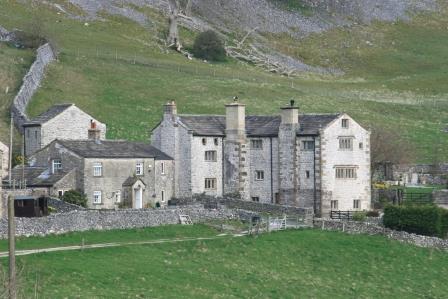
Kilnsey Old Hall, a grange of Fountains Abbey
(copyright the author, 2009)
The monasteries were a key part of the mediaeval economy and owned large areas of land and property. To provide money for the monks, lay brothers ran farms called granges* which not only provided food and clothing for the brothers but produce for sale. A key product was wool. Around 1200AD the abbey acquired land at Myton and established a grange there. The settlement which grew up around it was called Wyke and would become the town of Hull. Myton was ideally situated, where the river Hull flows out into the Humber, for the export of fleeces from the Abbey's lands to markets in Western Europe. Like many fine churches in East Anglia, Hull's beautiful Holy Trinity Church was built with the proceeds of the wool trade in around 1300

Holy Trinity Church, Hull
(copyright David Wright 2006,
used under creative commons license)
.

At this time, the Abbey was busily draining large areas of land in the Hull Valley and creating more pasture for livestock. In the process it formed many of the inland waterways which still link to the River Hull today. Beverley Beck, for example, is a very ancient watercourse that carried wool the couple of miles from from the town's market to the River Hull and down to the Humber.

'Wyke of Hull' rapidly became one of the most successful wool towns in the country. By 1205, only London, Boston, Southampton and Kings Lynn paid more in wool tax, and Wyke exceeded not only traditional local wool markets like Beverley and Hedon but also the city of York. Most of the wool merchants were from elsewhere, particularly the continental regions of Flanders, Holland, Germany and France. English merchants were from local wool towns like Beverley. Instead, the Abbey and inhabitants of Wyke made their money from port dues and from all the infrastructure that went with the mercantile trade such as inns. The Abbey was the effective civil as well as ecclesiastical authority in the town with its own jail and courts.

By the late 13th century Meaux Abbey had got itself into financial difficulties. It had also come to the attention of the King that Wyke was a much more favourable port than the ports of Ravenser and Hedon which already belonged to the crown. Thus in 1293 Edward I acquired the town and its port. The abbey was very disgruntled at the price, but presumably was not in a position to argue when the buyer was the king and when they were deep in debt. Thus came to an end the influence of the Cistercians in the area. In 1299 Edward I granted a royal charter and Wyke began a new era as 'the King's town on the river Hull'. It has proudly borne three gold crowns on its coat of arms ever since, although ironically has been something of a hot-bed of republicanism from the Civil War, when it refused entry to King Charles I, to the present day when it was the only city in the country not to apply for any licenses to hold a street party to commemorate the Queen's jubilee!

One look at a map shows the wisdom of Edward's choice. The town of Ravenser no longer exists at all, having been long since lost to coastal erosion, and the village of Hedon is now so far from water it is hard to believe it was once a port. Wyke, on the other hand, is now a city of more than 250,000 people and went on to become one of the wealthiest mercantile towns in the north. But more of that in a later post...

* A good example of a grange can be seen at Kilnsey in Wharfedale which belonged to Fountains Abbey. Wool was taken from Kilnsey along Mastiles Lane. This monastic drover's road can still be followed from Kilnsey to Malham and is a very pleasant walk of about 5 miles.